Glasgow
Scotland's largest city is less polished than Edinburgh and more relaxed about it. It has some of the best free museums in Britain and is the natural starting point for the west Highlands.
In short: Glasgow needs one or two days: its main museums, Kelvingrove, the Riverside and the Burrell, are free. It is also the best base for Loch Lomond (about 40 minutes) and the roads and railways to Oban, Glencoe and Fort William.
Last updated 12 November 2026.

Glasgow grew rich on trade and shipbuilding, and much of the centre is solid Victorian sandstone. Today it is known for music, galleries and food, and for being friendly to visitors. It is also the closest major city to Loch Lomond and the roads and railways that head north-west to Glencoe, Fort William, Oban and Skye.
Places to visit
5 places
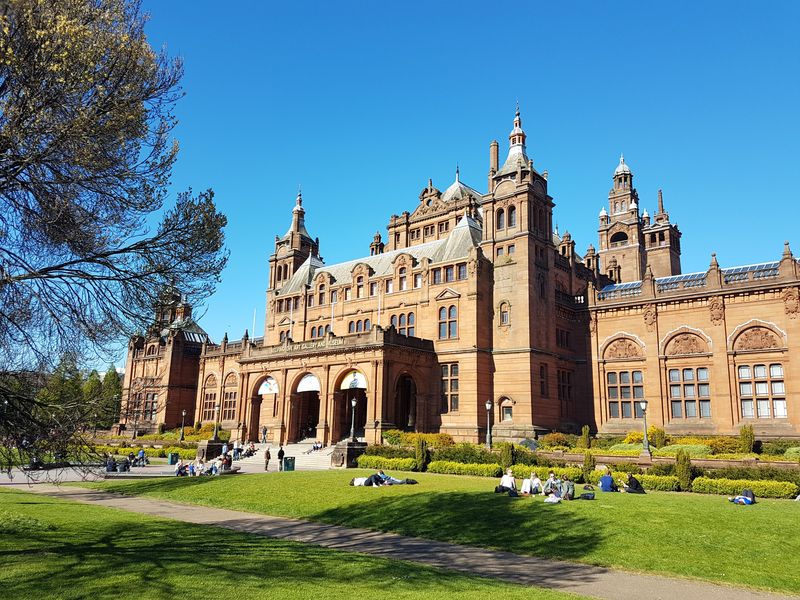 Kelvingrove Art Gallery and MuseumFree red sandstone museum with Dalí, the Glasgow Boys, Mackintosh and a Spitfire under one roof.Allow 2 hours
- Riverside MuseumFree museum of transport in a zigzag Zaha Hadid building, with a tall ship moored outside.Allow 1 hour 30 minutes to 2 hours
- Glasgow Cathedral and the NecropolisA complete medieval cathedral and a hilltop Victorian city of the dead beside it.Allow 1 hour 30 minutes for both
- The Burrell CollectionA shipowner's collection of medieval art, Chinese ceramics and Degas, in a glass gallery among trees.Allow 2 hours, plus time in the park
- Mackintosh at the WillowCharles Rennie Mackintosh's 1903 tea rooms, restored and serving tea again.Allow 1 hour
What to see
- Kelvingrove Art Gallery and Museum. A huge red-sandstone building in the West End with a varied collection, from natural history to Dalí's Christ of Saint John of the Cross. Free.
- Riverside Museum. Transport and city history on the Clyde, with the tall ship Glenlee moored outside. Free.
- The Burrell Collection. In Pollok Country Park on the south side, reopened in 2022 after a major refurbishment. Free.
- Glasgow Cathedral and the Necropolis. The cathedral is a rare example of a medieval Scottish church that survived the Reformation largely intact. The Victorian cemetery on the hill behind has wide views over the city.
- Charles Rennie Mackintosh. The architect's work is spread around the city and nearby: The Lighthouse, the Mackintosh at the Willow tea rooms on Sauchiehall Street, and the Hill House in Helensburgh (National Trust for Scotland). The Glasgow School of Art's Mackintosh Building was badly damaged by fires in 2014 and 2018 and is not open as a visitor attraction.
- The West End. Byres Road, Ashton Lane, the university and the Botanic Gardens make a good half day.
How long to stay
One or two days. Many people spend a night here at the start or end of a west-coast trip, when they are flying in or out of Glasgow Airport.
Getting in and around
- From the airport: Glasgow Airport has no rail link. An express bus runs to the city centre in about 15 to 25 minutes, and taxis are available. Glasgow Prestwick Airport, further south, has its own railway station.
- Stations: Glasgow has two main stations. Trains to Edinburgh, Stirling, Perth, Inverness, Oban, Fort William and Mallaig leave from Queen Street. Trains to England and the south-west leave from Central. They are a short walk apart.
- In the city: the Subway is a single circular line linking the centre and the West End. Buses and taxis cover the rest.
Going north and west from Glasgow
- Loch Lomond: Balloch, at the south end, is about 40 minutes by car or train. The A82 then runs the length of the loch towards Crianlarich and Glencoe.
- Glencoe: about 2 hours 15 minutes by car via the A82.
- Oban: about 2 hours 30 minutes by car, or about 3 hours by train.
- Fort William: about 2 hours 45 minutes to 3 hours by car, or about 3 hours 45 minutes on the West Highland Line, one of the most scenic railways in Britain.
- Arran: train to Ardrossan, then the CalMac ferry to Brodick. Check the operator, as sailings have at times run from Troon instead.
Glasgow questions
Is Glasgow or Edinburgh better for a Highlands trip?
Glasgow is closer to the west Highlands, Loch Lomond, Glencoe, Oban and Skye. Edinburgh is better placed for Perthshire, the Cairngorms and the A9 to Inverness. Many visitors fly into one and out of the other.
Which Glasgow station do trains to the Highlands leave from?
Queen Street. That includes the West Highland Line to Oban, Fort William and Mallaig, and trains to Perth and Inverness.